Skip to content
indraft
Start free

Who it is for

It is for you

Some people read one line about Indraft and know. Everybody else is already living the problem it solves and has not filed it under "CRM" yet. This page is for both of you.

If you already know

You are running an agent and your CRM is the holdout

It drafts your follow-ups, it reads your inbox, it knows more about last week than your CRM does. The one place it cannot reach is the system of record, so you keep being the integration between them.

Indraft is a CRM your agent operates directly: every object, every write, every read, through the same tools a person uses. Not an integration bolted to the side of one, which is why the whole product can assume a machine is doing most of the writing.

If you do not know it yet

You will recognise at least one of these

None of these sound like a CRM problem, which is exactly why they have gone unfixed. They are all the same problem.

You have asked an agent about a customer

Where did it look? Not your CRM, because it cannot get in. It read your inbox, or your notes, or it guessed. The answer was decent and nothing about it got written down anywhere the rest of the company can see.

The real work lives in a spreadsheet next to the CRM

Candidates, campaigns, units, matters, shipments. Whatever your business is actually about, no CRM has a place for it, so it sits in a sheet that nobody links and everybody edits.

Keeping the CRM correct is somebody's job

Not their whole job, but an hour a week that produces nothing and stops the moment they are busy. The data decays from that day and the reports keep coming out anyway.

You do not trust a field you did not type

Somebody enriched this account, or an integration did, or a colleague did in a hurry. You cannot tell which, so you check it yourself before you use it, every time.

Each of those is a record that should exist and does not, or one that exists and cannot be trusted. That is the whole subject: not storing customer data, which every CRM does, but keeping it true while something other than a person is writing it.

What changes

The CRM stops being work

The reason CRM data rots is that keeping it correct is a chore assigned to the people with the least time. Give that job to the thing that does not mind doing it, and the question stops being whether anybody updated the record and becomes whether you can trust what they wrote.

Which is why the interesting half of this product is not the writing. It is that every value carries how it was come by, every change can be undone, and identity is never guessed. An agent that writes a thousand records a day is only useful if you can still believe the thousandth.

The cookbook is the honest version of this: real jobs, run against the real product, including what it refuses to do.
The human side

What you actually look at

Your agent writes through the API and the tool set. You read, correct, and undo here. These are captures of the running application, not drawings: the same pages the product serves, rendered by the same code.

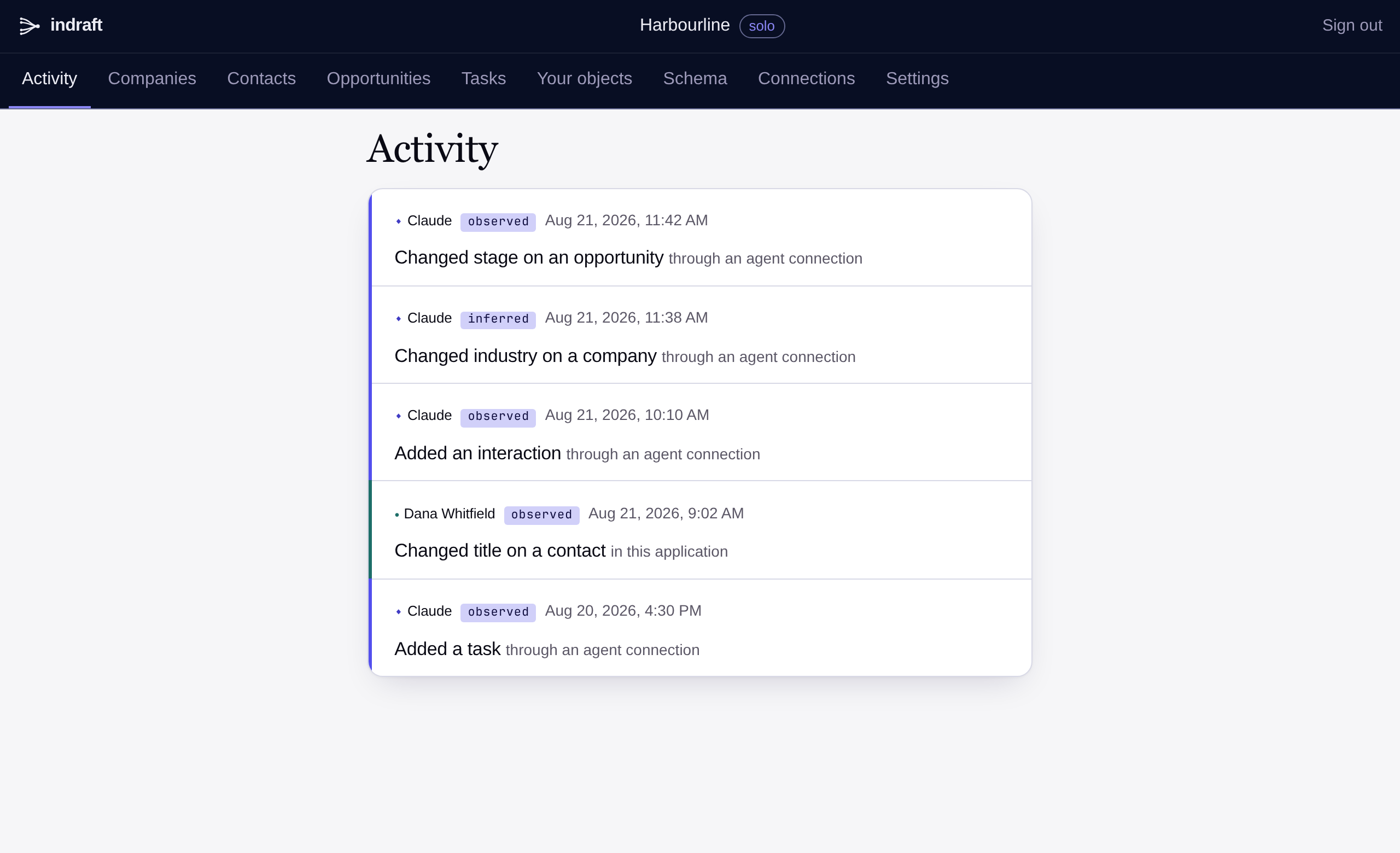
The one that matters most is the first. Every change carries who made it, whether they observed it or inferred it, which surface it came through, and an Undo where the change can be safely compensated. That is the difference between a CRM an agent writes to and a CRM you can still trust afterwards.

The Indraft activity feed. Five changes, four by an agent called Claude and one by a person, Dana Whitfield, each marked as observed or inferred, timestamped, described in a plain sentence such as Changed stage on an opportunity, and labelled with where it came from: through an agent connection, or in this application.
Activity. Claude wrote four of these and a person wrote one, and the feed says which is which.
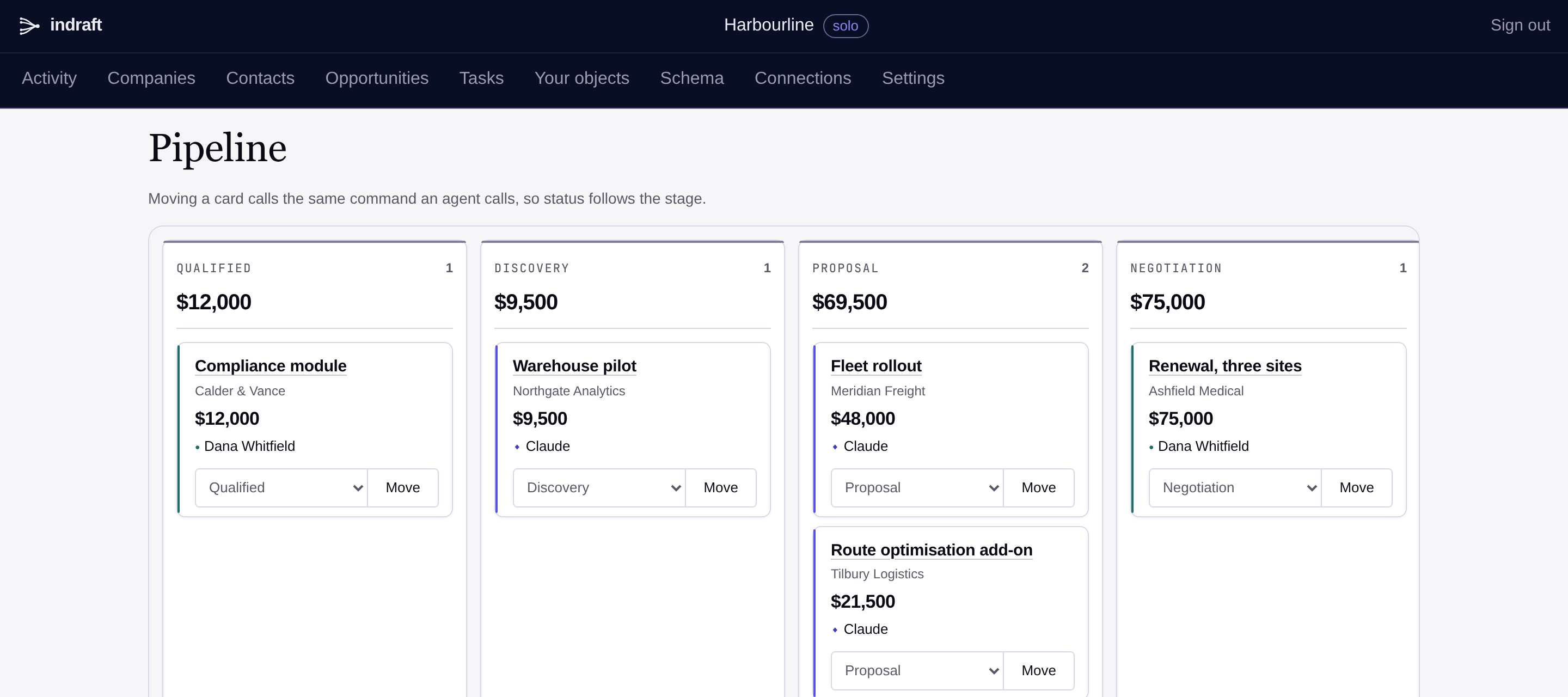
The Indraft pipeline board. Four stage columns with deal cards showing the company, the amount, and the actor who last touched it.
The pipeline. Moving a card calls the same command an agent calls, so the two can never disagree about what stage means.
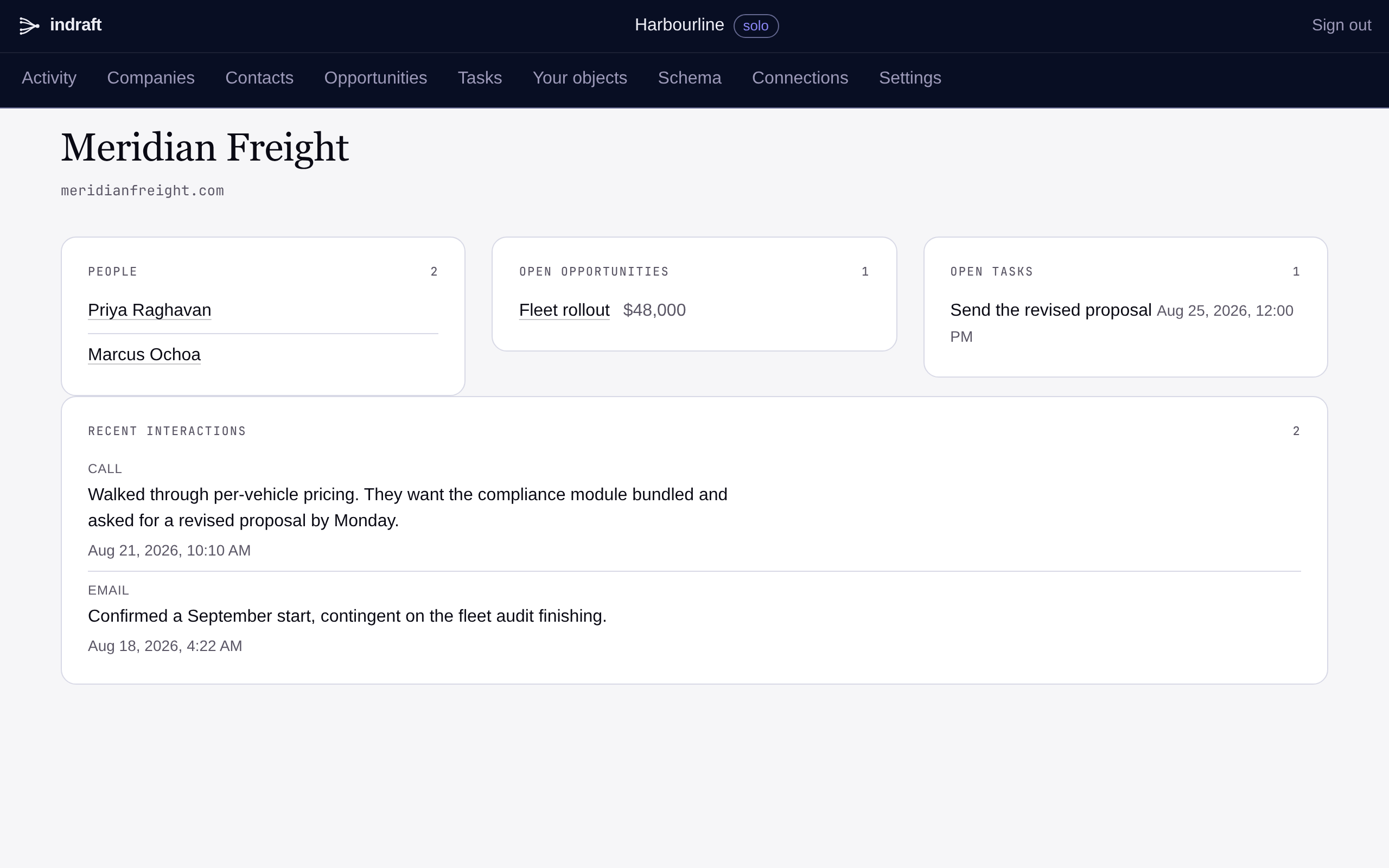
An Indraft company record. Meridian Freight, with its people, open opportunities, open tasks, and recent interactions, each interaction summarised in a sentence.
A record with its context: people, open work, and what was said, in bounded amounts rather than an infinite feed.

Next

Find out on your own data

The free plan is enough. Connect the agent you already run, point it at whatever list you already have, and judge the CRM it builds in twenty minutes.

Start where you already are

If your agent runs on Claude, the connection path is the shortest one. If you are wiring your own service, start with the REST API or the MCP tool set. If your business is about something a CRM has never heard of, define it.